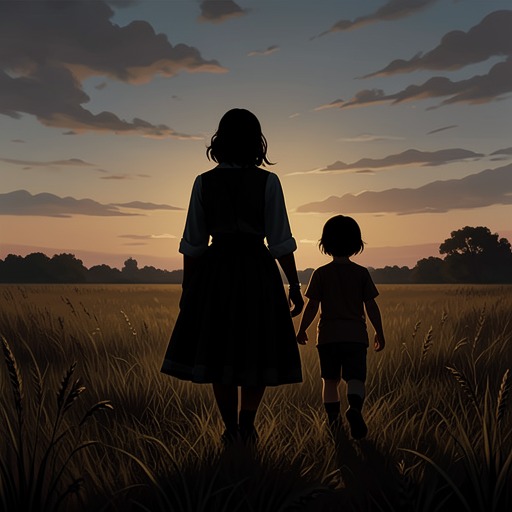
Blanca's mother
También esto pasaráBlanca’s mother is the charismatic, demanding center of Blanca’s memories of family life in Cadaqués, and her death turns those memories into both refuge and pain. A woman with a fierce appetite for living, she filled her home with friends, rituals, and instruction; in old age and illness, she gradually lost strength and the world that had gathered around her. For Blanca, remembering her means holding those changes together: the mother who could make a house feel expansive, the mother whose love could weigh heavily, and the mother whose absence leaves her daughter unsure where she belongs.
Identity and presence
Blanca’s mother appears through the recollections of her adult daughter, who is forty at the funeral and struggles to accept that the death is real. The portrait is not of a distant or easily summarized parent. She was socially magnetic, surrounded by friends with whom she laughed, played cards until dawn, traveled, and swam naked in the sea. Blanca remembers those adults as a chosen family, people who made the summers in Cadaqués feel full of possibility. Their later absence is part of the loss: some are dead, others have disappeared from her life, and the old circle no longer gathers around the house.
Her forcefulness was evident in ordinary domestic scenes. In a long summer tunic, with unruly ash-colored hair, she could stand at the top of the stairs and issue the day’s instructions like a general addressing her troops. Even from her bedroom she might call into a conversation on the terrace with a funny or cutting observation. The house’s open doors and the regular pattern of meals, boat trips, siestas, and card games belonged to a life she animated. Her presence could make the familiar seem lively and shared; its loss makes the house feel emptied out, even before Blanca can bring herself to enter her mother’s beautiful bedroom.
Love, distance, and inheritance
The bond between mother and daughter was powerful but not uncomplicated. Blanca believes her mother loved her, yet remembers feeling that the mother’s happiness had gradually been placed on her shoulders. The burden persisted even when Blanca was far away, and she eventually withdrew somewhat because she feared that staying close would bring them both down. In the aftermath of the death, she admits that she no longer trusts anyone’s love easily; even her mother, she feels, stopped loving her for a time. Grief therefore includes injury and uncertainty alongside attachment.
They were not confidantes or simply friends. Blanca recalls that each tried to present a more composed version of herself to the other, and that she kept her romantic life at a distance, instinctively protecting it from her mother’s intense combination of generosity, lucidity, love, and self-interest. Her mother watched her fall in and out of love and recover from heartbreak without taking over those experiences. Blanca understands that distance as a form of restraint: her mother let her suffer and find her footing without much intervention. At the same time, Blanca regards their bond as foundational, believing that later loves echo the first love formed in childhood. She sees her mother’s influence in the fierce, unguarded love she feels for her children.
That inheritance becomes painfully concrete in memory. Blanca can no longer open a book without thinking of her mother’s concentrated attention to books, or wishing she could see her face again. More than losing the person who looked at her, she has lost the gaze in which she had located her place in the world. She had remained a child, she reflects, through two children of her own, two marriages, other relationships, homes, and jobs. Becoming an orphan at forty makes adulthood feel less like a settled identity than an uncertain transition.
The house, the dog, and chosen family
The mother’s influence extended beyond the parent-child relationship into a network of shared care. Guillem, Blanca’s former partner and the father of her older child, is described as having a loving, contentious bond with Blanca’s mother. She had made Patum, a dog who had once belonged to Blanca and Guillem as a couple, part of her own household. When her illness left her unable to keep the dog, she accepted that Patum should go with them. Blanca recognized this surrender as a sign that her mother was nearing the end: the woman who had once made room in her life for others was beginning to let go of what she loved.
Patum nevertheless attended the funeral with Guillem. He put a black ribbon on the dog’s collar, and she sat formally in the shade beside him. Blanca imagines her mother beside them, one hand resting on Patum’s head, silently witnessing the ceremony. The image joins the mother’s affection for the dog to the practical ties among people who had once formed a family together. After the funeral, Patum waits at the door of the mother’s room and sniffs around the house for her scent. Blanca does the same in another way, imagining that she might find her mother again by revisiting places they had traveled together. The dog’s searching makes grief visible as a shared, bodily habit rather than an abstract idea.
Age, illness, and farewell
In old age, the fearless woman Blanca remembers became frightened as her strength, clarity, and circle of friends failed her. She had once fought every battle and expected to win; by the last day, Blanca believes, she knew the game was lost. The family’s routines in Cadaqués could continue almost unchanged while happiness itself slowly altered. The doors that had stood open to everyone began to close, and the house seemed to age and become solitary alongside its owner.
During the mother’s final hospitalization, Blanca tried to reassure her. It was the third bout of pneumonia, she said; she would recover, the children would be all right, and everything was in order. Her mother could no longer speak. She looked directly at Blanca and wept silently, without moving her face. A friend present in the room suggested that the air conditioning had irritated her eyes, but Blanca understood the tears as a farewell. She held her mother’s hand and repeated her reassurance, offering comfort even as she recognized what was happening.
That moment followed an earlier, quieter parting. Months before, when death still seemed impossible to Blanca, her mother had said that knowing her had been an honor. Blanca had laughed and dismissed the remark, and within minutes they were arguing again. In retrospect, the exchange marks a turn from unfinished conversation toward finality. At the funeral, Blanca is exhausted, overheated, and overwhelmed by the road back to the village; she even finds herself unable to stop noticing an attractive stranger. Such ordinary, involuntary perceptions do not cancel grief. They show the living body continuing to register the world while the mind struggles to absorb the loss.
Narrative significance
Blanca’s mother remains present in the narrative through recurring objects and places: the house, the bedroom, the family dog, books, and the route to Cadaqués. From the terrace, Blanca recalls generations of family life and the sequence of summers, children, separations, and deaths that gathered there. The morning light and calm sea can make the landscape seem to deny every tragedy, while the remembered changes inside the house insist that time has passed. The same setting is both a refuge of childhood memory and a place from which loss cannot be escaped.
The portrait resists reducing the mother either to a saint or to the source of Blanca’s pain. Her love could be generous and burdensome; her lively home could shelter a chosen family, yet the relationships it held were vulnerable to illness, time, and disappearance. By remembering her in gestures as particular as giving up Patum, directing the day from the stairs, or silently crying in the hospital, Blanca keeps the woman’s contradictions intact. The mother’s death breaks the daughter’s old sense of being securely seen, but the act of recollection preserves the mother’s ways of looking, laughing, caring, and occupying a room.